고정 헤더 영역
상세 컨텐츠
본문
딥러닝 데이터 표현과 연산
- 데이터 표현을 위한 기본 구조로 텐서(tensor)를 사용
- 텐서는 데이터를 담기위한 컨테이너(container)로서 일반적으로 수치형 데이터를 저장
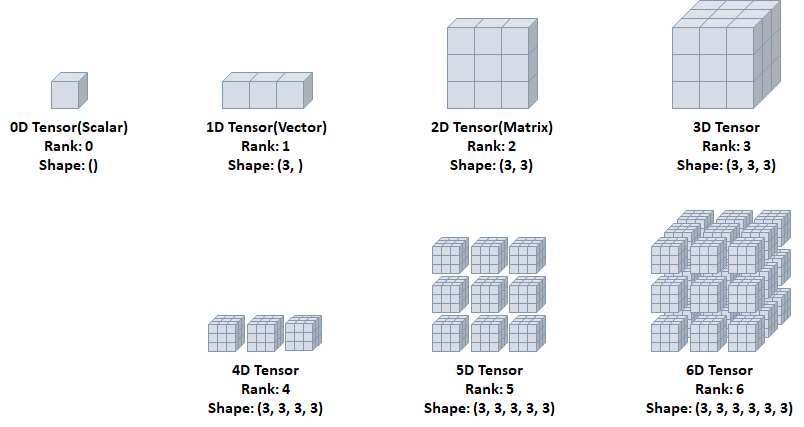
텐서(Tensor)
- Rank: 축의 개수
- Shape: 형상(각 축에 따른 차원 개수)
- Type: 데이터 타입
import numpy as np
import tensorflow as tf
0D Tensor(Scalar)
- 하나의 숫자를 담고 있는 텐서(tensor)
- 축과 형상이 없음
t0= tf.constant(1)
print(t0)
출력
tf.Tensor(1, shape=(), dtype=int32)
1D Tensor(Vector)
- 값들을 저장한 리스트와 유사한 텐서
- 하나의 축이 존재
t1=tf.constant([1,2,3])
print(t1)
print(tf.rank(t1))
출력
tf.Tensor([1 2 3], shape=(3,), dtype=int32)
tf.Tensor(1, shape=(), dtype=int32)
2D Tensor(Matrix)
- 행렬과 같은 모양으로 두개의 축이 존재
- 일반적인 수치, 통계 데이터셋이 해당
- 주로 샘플(samples)과 특성(features)을 가진 구조로 사용
t2= tf.constant([[1,2,3],
[4,5,6],
[7,8,9]])
print(t2)
print(tf.rank(t2))
출력
tf.Tensor(
[[1 2 3]
 [4 5 6]
 [7 8 9]], shape=(3, 3), dtype=int32)
tf.Tensor(2, shape=(), dtype=int32)
코드텍스트
3D Tensor
- 큐브(cube)와 같은 모양으로 세개의 축이 존재
- 데이터가 연속된 시퀀스 데이터나 시간 축이 포함된 시계열 데이터에 해당
- 주식 가격 데이터셋, 시간에 따른 질병 발병 데이터 등이 존재
- 주로 샘플(samples), 타임스텝(timesteps), 특성(features)을 가진 구조로 사용
t3= tf.constant([[[1,2,3],
[4,5,6],
[7,8,9]],
[[1,2,3],
[4,5,6],
[7,8,9]],
[[1,2,3],
[4,5,6],
[7,8,9]]])
print(t3)
print(tf.rank(t3))
출력
tf.Tensor( [[[1 2 3] [4 5 6] [7 8 9]] [[1 2 3] [4 5 6] [7 8 9]] [[1 2 3] [4 5 6] [7 8 9]]], shape=(3, 3, 3), dtype=int32) tf.Tensor(3, shape=(), dtype=int32)
텐서 데이터 타입
- 텐서의 기본 dtype
- 정수형 텐서: int32
- 실수형 텐서: float32
- 문자열 텐서: string
- int32, float32, string 타입 외에도 float16, int8 타입 등이 존재
- 연산시 텐서의 타입 일치 필요
- 타입변환에는 tf.cast() 사용
i=tf.constant(2)
출력
<tf.Tensor: shape=(), dtype=int32, numpy=2>
f=tf.constant(2.)
f
출력
<tf.Tensor: shape=(), dtype=float32, numpy=2.0>
s=tf.constant('sdf')
print(s)
출력
tf.Tensor(b'sdf', shape=(), dtype=string)
텐서 연산
print(tf.constant(2)+tf.constant(2))
print(tf.constant(2)-tf.constant(2))
print(tf.add(tf.constant(2),tf.constant(2)))
print(tf.subtract(tf.constant(2),tf.constant(2)))
출력
tf.Tensor(4, shape=(), dtype=int32) tf.Tensor(0, shape=(), dtype=int32) tf.Tensor(4, shape=(), dtype=int32) tf.Tensor(0, shape=(), dtype=int32)
print(tf.constant(2)*tf.constant(2))
print(tf.constant(2)/tf.constant(2))
print(tf.multiply(tf.constant(2),tf.constant(2)))
print(tf.divide(tf.constant(2),tf.constant(2)))
출력
tf.Tensor(4, shape=(), dtype=int32) tf.Tensor(1.0, shape=(), dtype=float64) tf.Tensor(4, shape=(), dtype=int32) tf.Tensor(1.0, shape=(), dtype=float64)
'딥러닝 기초 이론 > 딥러닝 파이썬 실습' 카테고리의 다른 글
| CNN 한번에 끝내기 (0) | 2023.02.14 |
|---|---|
| Fashion_mnist.load_data로 케라스 튜너 사용해서 성능 높여보기 (0) | 2023.02.10 |
| 딥러닝으로 꽃 분류하기 (0) | 2023.02.10 |
| 3.MNIST 딥러닝 모델 예제 (0) | 2023.02.05 |
| 2.딥러닝 구조 (0) | 2023.02.05 |


